
BASICS OF NURSING - 1
A COMPLETE GUIDE ALIGNED WITH NABH, JCI & WHO STANDARDS
Introduction
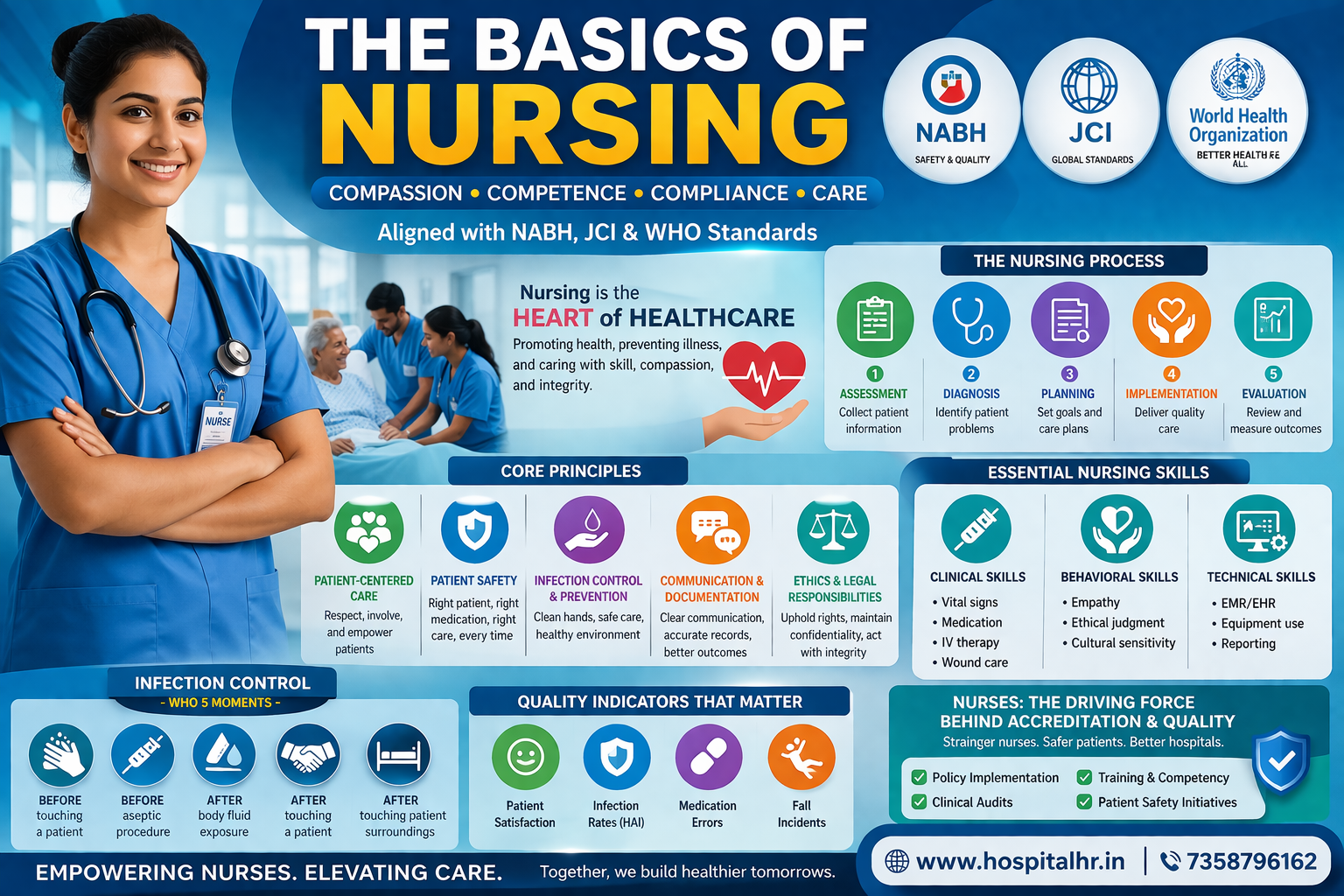
Nursing is the backbone of healthcare delivery. It is not just about patient care—it is about safety, compassion, clinical excellence, and compliance.
In today’s healthcare environment, nursing practices must align with global and national standards such as:
- NABH (National Accreditation Board for Hospitals & Healthcare Providers)
- JCI (Joint Commission International)
- WHO (World Health Organisation)
This blog outlines the fundamentals of nursing with a structured, compliance-driven approach.
1. Definition & Scope of Nursing
Nursing is a profession focused on:
- Promotion of health
- Prevention of illness
- Care of the sick, disabled, and dying
- Advocacy for patients and communities
As per the WHO, nursing also includes leadership, education, and research responsibilities.
2. Core Principles of Nursing Practice
A. Patient-Centred Care
- Respect patient dignity, values, and preferences
- Involve patients and families in decision-making
- Ensure emotional and psychological support
Aligned with NABH Patient Rights & JCI Patient-Centred Standards
B. Patient Safety
- Correct patient identification (2 identifiers)
- Medication safety (5 Rights: Right patient, drug, dose, route, time)
- Fall prevention protocols
Strongly aligned with JCI International Patient Safety Goals (IPSG)
C. Infection Prevention & Control (IPC)
- Hand hygiene (WHO 5 Moments)
- Use of PPE
- Biomedical waste segregation
Critical NABH & WHO compliance requirement
D. Communication & Documentation
- Accurate nursing records
- SBAR communication (Situation, Background, Assessment, Recommendation)
- Timely reporting of critical values
Mandatory for legal, quality, and accreditation standards
3. Nursing Process (Clinical Framework)
The nursing process is a systematic method followed globally:
- Assessment – Collect patient data
- Diagnosis – Identify patient problems
- Planning – Set measurable goals
- Implementation – Deliver care
- Evaluation – Review outcomes
This structured approach is required in both NABH & JCI audits
4. Essential Nursing Skills
Clinical Skills
- Vital signs monitoring
- Medication administration
- IV therapy
- Wound care
Behavioral Skills
- Empathy and compassion
- Ethical decision-making
- Cultural sensitivity
Technical Skills
- Use of EMR/EHR systems
- Medical equipment handling
- Reporting & dashboards
5. Nursing Documentation Standards
Proper documentation must be:
- Accurate
- Complete
- Legible
- Time-bound
Golden Rule:
"If it is not documented, it is not done."
Directly impacts NABH audits & medico-legal safety
6. Infection Control in Nursing (WHO Focus)
WHO 5 Moments of Hand Hygiene
- Before touching the patient
- Before aseptic procedure
- After body fluid exposure
- After touching the patient
- After touching the surroundings
Additional Practices
- Isolation protocols
- Sterilisation and disinfection
- Antibiotic stewardship
7. Ethical & Legal Responsibilities
Nurses must adhere to:
- Patient confidentiality
- Informed consent
- Respect for patient rights
- Professional accountability
Aligned with NABH Ethics Committee & JCI Governance Standards
8. Quality Indicators in Nursing
Hospitals track nursing performance through:
- Patient satisfaction scores
- Infection rates (HAI)
- Medication errors
- Fall incidents
These indicators are essential for NABH & JCI quality metrics
9. Role of Nursing in Accreditation (NABH & JCI)
Nurses play a critical role in:
- Policy implementation
- Clinical audits
- Training & competency
- Patient safety initiatives
In reality:
No hospital can achieve accreditation without a strong nursing system.
10. Future of Nursing
With digital transformation, nursing is evolving:
- Tele-nursing
- AI-assisted care
- Electronic Health Records (EHR)
- Continuous Learning via LMS (like HospitalHR.in)
Conclusion
Nursing is not just a profession—it is a system-driven, compliance-oriented, patient-focused discipline.
To deliver high-quality healthcare, hospitals must:
- Train nurses continuously
- Align practices with NABH, JCI, and WHO
- Use technology platforms like HospitalHR.in for training, tracking, and compliance
Call to Action
Empower your nursing workforce with structured training and compliance tools.
Visit www.hospitalhr.in
Call: 7358796162

Comments (0)
No comments yet. Be the first to comment!