
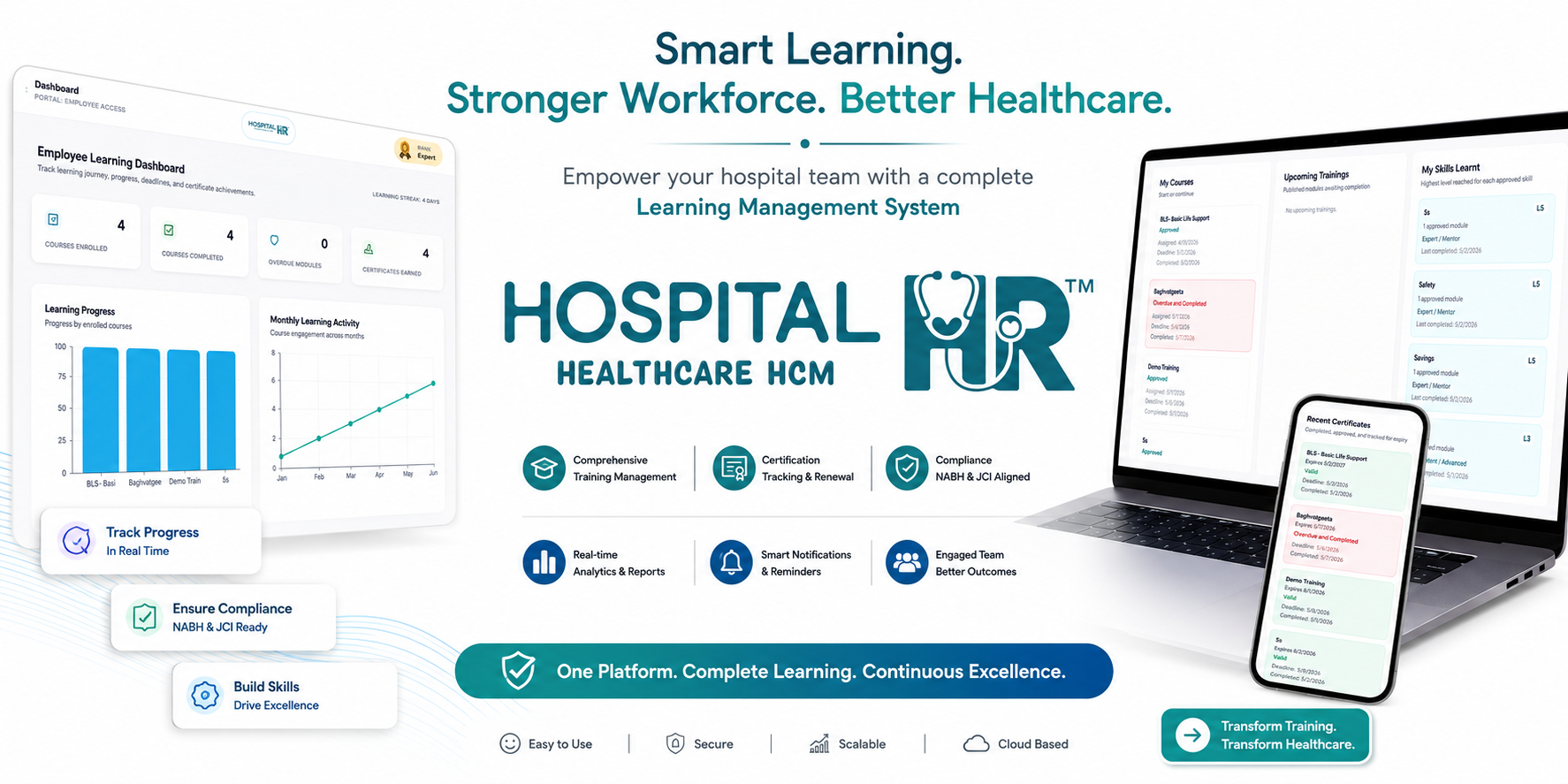
HospitalHRTM LMS
Employee Login Dashboard for Smart Healthcare Learning Management
In today’s healthcare environment, hospitals must ensure that every employee is continuously trained, assessed, certified, and compliant with organisational standards. Traditional training methods are no longer sufficient for modern hospitals aiming to achieve operational excellence, NABH accreditation, and JCI compliance.
HospitalHR LMS Dashboard provides an advanced Employee Login Dashboard that enables healthcare professionals to access training programs, track progress, complete mandatory modules, and maintain certification records within a centralised digital learning ecosystem.
Reference:
NABH: HRM Chapter – HRM.1, HRM.2, HRM.3, HRM.4 (Human Resource Management, Staff Training & Competency Development)
JCI: SQE Chapter – SQE.1, SQE.2, SQE.3, SQE.8 (Staff Qualifications & Education)
Employee Learning Dashboard – Centralised Training Experience
The Employee Learning Dashboard acts as a personalised learning control centre for every hospital employee. It provides real-time visibility into assigned courses, completed modules, overdue training, earned certificates, and skill development progress. The dashboard is designed to improve employee engagement while ensuring organisational compliance with hospital training requirements.
Healthcare organisations can monitor learning participation across departments, including Nursing, Doctors, Allied Health Professionals, Administration, Front Office, Quality Teams, Biomedical Teams, and Support Services.
Reference:
NABH: HRM.2.a, HRM.3.a, HRM.4.a (Training Planning, Staff Competency Monitoring, Continuing Education)
JCI: SQE.4, SQE.5, SQE.6 (Staff Orientation, Education and Competency Assessment)
1. Courses Enrolled
The “Courses Enrolled” section displays the total number of training modules assigned to an employee. These courses may include mandatory compliance training, departmental SOPs, patient safety modules, infection control education, emergency preparedness programs, and role-based competency training.
This feature ensures that employees clearly understand their assigned learning responsibilities and can systematically complete their training schedules without confusion.
Reference:
NABH: HRM. 2. b, HRM. 2. c (Employee Orientation and Mandatory Training Programs)
JCI: SQE.1.1, SQE.1.2 (Staff Education Requirements and Training Assignment)
2. Trainings Completed
The “Trainings Completed” module tracks completed learning programs. It enables employees and hospital administrators to monitor completion percentages and competency achievement levels.
Hospitals can use this feature during internal audits, NABH assessments, and quality reviews to demonstrate evidence of staff training completion and competency development.
Reference:
NABH: HRM. 3. b, HRM. 3. c (Competency Assessment and Training Documentation)
JCI: SQE.3, SQE.4.1 (Staff Competency Validation and Educational Records)
3. Overdue Modules
The “Overdue Modules” feature identifies training programs that are pending or delayed and require immediate attention from employees. Automated tracking helps hospitals reduce non-compliance risks and improve accountability across departments.
This feature is especially useful during accreditation audits, where hospitals must demonstrate completion timelines for training and staff compliance records.
Reference:
NABH: HRM. 4. d, HRM.5.a (Monitoring Training Compliance and Corrective Actions)
JCI: SQE.5.1, SQE.5.2 (Monitoring Staff Education Compliance)
4. Certificates Earned
The LMS dashboard automatically records and displays certificates earned after successful completion of approved courses and assessments. Employees can maintain digital proof of their competency and skill achievements on a centralised platform.
Hospitals can use certificate tracking to manage mandatory annual renewals such as BLS, Fire Safety, Infection Control, Biomedical Waste Management, and Occupational Safety Training.
Reference:
NABH: HRM. 3. d, HRM. 4. b (Training Records and Certification Tracking)
JCI: SQE.8, SQE.8.1 (Credentialing and Staff Qualification Documentation)
5. Learning Progress
The “Learning Progress” section visually represents employee course completion percentages through graphical dashboards and analytics. Employees can easily monitor their learning journey and identify incomplete modules.
For hospital management, this feature supports data-driven decision-making by identifying departments requiring additional training interventions or support.
Reference:
NABH: HRM.4.a, HRM. 4. c (Continuous Monitoring of Training Effectiveness)
JCI: SQE.6, SQE.6.1 (Measurement of Education Outcomes)
6. Monthly Learning Activity
Monthly Learning Activity analytics provide insight into employee engagement trends across different months. Hospitals can evaluate participation levels, training consistency, and organisational learning culture using measurable data.
This feature supports hospital leadership in planning annual training calendars and workforce development strategies.
Reference:
NABH: HRM. 2. d, HRM. 4. e (Continuous Professional Education and Staff Development)
JCI: SQE.7, SQE.7.1 (Staff Development and Learning Improvement Programs)
7. Skill Level Report
The Skill Level Report measures competency levels achieved by employees after completing approved training modules. Skills may be categorised as Beginner, Competent, Advanced, Expert, or Mentor levels depending on assessment outcomes.
This helps hospitals identify internal trainers, departmental champions, and future leadership candidates while strengthening workforce competency management.
Reference:
NABH: HRM.3.e, HRM.5.b (Competency-Based Skill Evaluation Systems)
JCI: SQE.3.1, SQE.3.2 (Staff Competency Assessment and Validation)
8. Notifications
The Notifications panel provides real-time alerts regarding newly assigned training programs, pending assessments, certificate renewals, policy updates, and compliance deadlines.
Automated reminders improve employee responsiveness and significantly reduce missed training deadlines within hospital operations.
Reference:
NABH: HRM. 2. e, HRM. 4. f (Training Communication and Employee Awareness Systems)
JCI: SQE.5.3, SQE.6.2 (Staff Communication and Education Coordination)
9. Learning History
The Learning History module maintains a complete digital audit trail of employee learning activities, including course completion dates, overdue status, approvals, and historical certifications.
This centralised learning record is highly beneficial during inspections, audits, accreditation reviews, and internal quality assessments.
Reference:
NABH: HRM. 3. f, HRM. 5. c (Employee Record Maintenance and Documentation Control)
JCI: SQE.8.2, SQE.8.3 (Educational Documentation and Staff Records)
10. My Courses
The “My Courses” section provides employees with quick access to assigned mandatory and optional training programs. It includes assignment dates, completion deadlines, course status, and completion history.
This simplified interface improves user experience and enhances employee participation in hospital learning initiatives.
Reference:
NABH: HRM. 2. f, HRM.4.g (Employee Access to Training Programs)
JCI: SQE.1.3, SQE.4.2 (Accessibility of Staff Education Systems)
11. Upcoming Trainings
The Upcoming Trainings module displays future scheduled learning activities and training programs awaiting completion. Hospitals can proactively communicate mandatory sessions and improve training preparedness across departments.
This feature strengthens organisational training planning and scheduling efficiency.
Reference:
NABH: HRM.2.g, HRM.4.h (Training Scheduling and Educational Planning)
JCI: SQE.7.2, SQE.7.3 (Ongoing Staff Development Planning)
12. My Skills Learned
The “My Skills Learnt” feature highlights competencies achieved through approved training modules. Employees can track their professional growth and demonstrate expertise across clinical and non-clinical areas.
This module supports workforce capability mapping and helps hospitals build a strong competency-driven healthcare culture.
Reference:
NABH: HRM.3.g, HRM. 5. d (Employee Skill Development and Competency Building)
JCI: SQE.3.3, SQE.6.3 (Capability Development and Learning Effectiveness)
13. Recent Certificates
The Recent Certificates section displays the latest approved certifications, including expiry dates, renewal tracking, and compliance status. Hospitals can efficiently monitor the validity of certifications and avoid compliance gaps.
Automated visibility into expiring certifications supports proactive workforce readiness and accreditation preparedness.
Reference:
NABH: HRM.3.h, HRM. 5. e (Certification Renewal and Compliance Tracking)
JCI: SQE.8.4, SQE.8.5 (Credential Renewal and Competency Verification)
Why HospitalHR LMS Employee Login is Important for Hospitals
Modern hospitals require a centralised digital platform that integrates employee training, competency assessment, certification management, compliance tracking, and learning analytics into a single system.
Hospital HR LMS enables healthcare organisations to achieve:
- Improved staff competency management
- Better NABH and JCI compliance readiness
- Automated training workflows
- Centralised certification tracking
- Enhanced employee engagement
- Real-time learning analytics
- Reduced manual training administration
- Better audit preparedness
- Continuous professional development
- Digital transformation of hospital learning systems
Reference:
NABH: HRM.1 to HRM.5 (Integrated Human Resource Management Standards)
JCI: SQE.1 to SQE.8 (Comprehensive Staff Qualification & Education Standards)
Book Free Demo || Access Free Software Now
Conclusion
The HospitalHR LMS Employee Login Dashboard transforms hospital training into a structured, measurable, and compliance-driven process. By integrating learning management, competency tracking, certifications, analytics, and employee engagement into one intelligent platform, hospitals can strengthen workforce performance while aligning with NABH and JCI international standards.
As healthcare continues to evolve, digital learning platforms like Hospital HR LMS will play a critical role in building highly skilled, compliant, and patient-focused healthcare teams.
Reference:
NABH: HRM Chapter – HRM.1, HRM.2, HRM.3, HRM.4, HRM.5
JCI: SQE Chapter – SQE.1, SQE.2, SQE.3, SQE.4, SQE.5, SQE.6, SQE.7, SQE.8
Training Key Words for Managers - Reference:
HospitalHR LMS Dashboard, Healthcare LMS, Hospital Learning Management System,
Employee Learning Dashboard, Hospital, Training Software, Smart Healthcare Learning,
Healthcare Employee Training, LMS Login Dashboard, Hospital Staff Training Platform,
Healthcare Workforce Development, Employee Productivity Management

Comments (0)
No comments yet. Be the first to comment!