
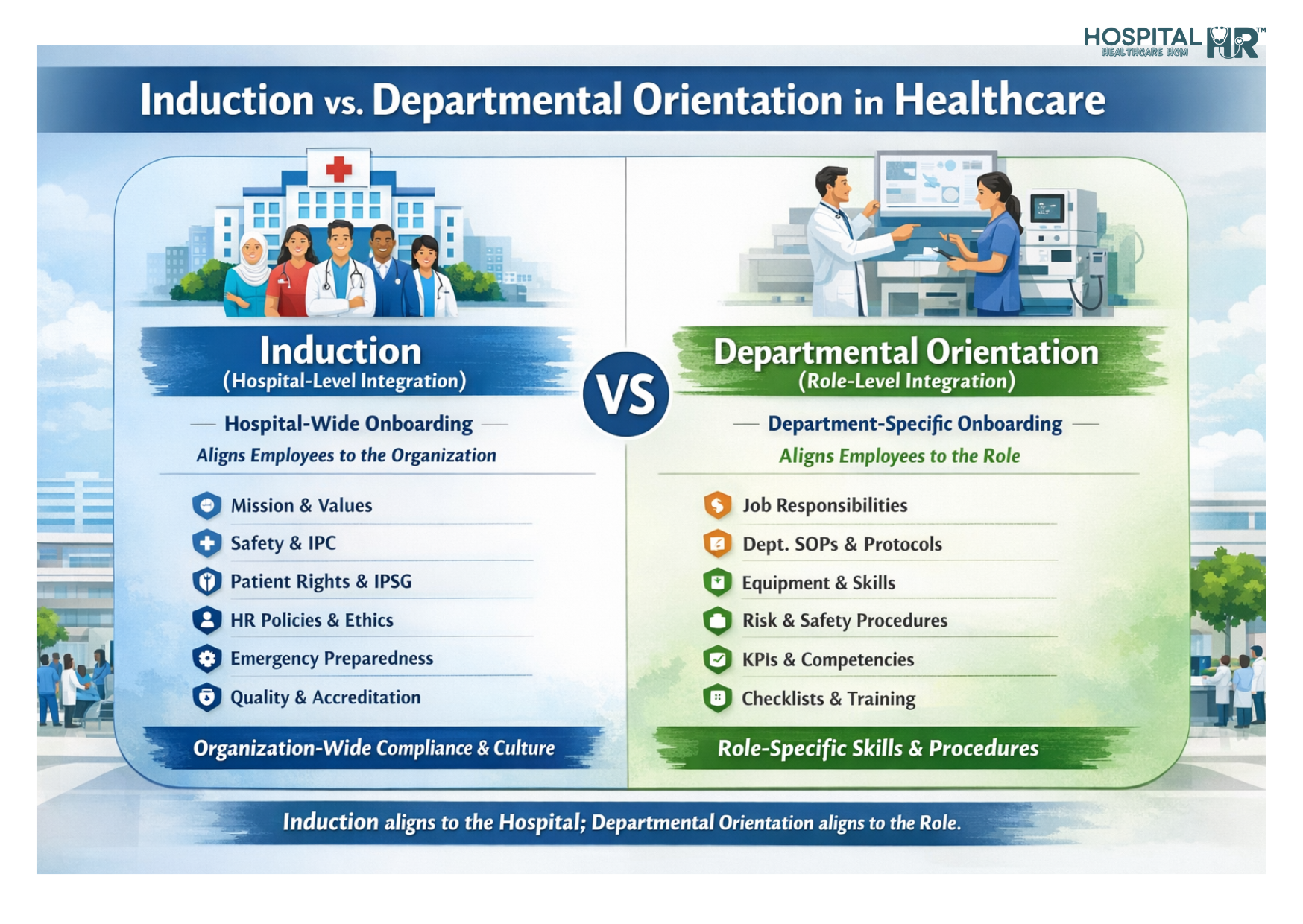
HR Induction vs. Departmental Orientation — Key Difference in Healthcare Context
1. Induction (Hospital-Level Integration)
Induction is a hospital-wide onboarding designed to Integrate New Employees into the organisation’s mission, culture, values, and mandatory compliance expectations.
Primary Purpose:
To ensure every new joiner understands the hospital’s systems, ethics, safety requirements, and accreditation standards before assuming role duties.
Key Components (as per JCI & NABH intent):
-
Organisation Vision, Mission & Values
-
Code of Conduct & Ethics
-
HR Policies & Employee Rights
-
Fire & Life Safety / Environment of Care (EoC)
-
Hospital Safety Programs
-
Infection Prevention & Control (IPC)
-
Patient Safety Goals (IPSG) / Patient Rights & Education (PRE)
-
Data & Medical Record Confidentiality (HIPAA equivalents)
-
IT, Information Security & Digital Platforms
-
Emergency Preparedness & Disaster Management
-
Hospital-wide HR & Legal Compliance
-
Quality & Accreditation Overview (NABH/JCI frameworks)
Outcome Expected:
The employee becomes compliant, safe, culture-aligned, audit-ready, and aware of mandatory protocols across the hospital.
2. Departmental Orientation (Role-Level Functional Integration)
Departmental Orientation is a unit/department-specific onboarding tailored to the employee’s job role, responsibilities, workflows, equipment, and team dynamics in their area of posting.
Primary Purpose:
To ensure clinical or non-clinical operational competence, accuracy in departmental processes, and compliance with JCI & NABH departmental standards.
Key Components (as per JCI & NABH intent):
-
Specific Job Role & Reporting Structure
-
Departmental SOPs / Workflows
-
Equipment, Tools, Instruments & Software Use
-
Clinical/Non-Clinical Safety Requirements
-
Departmental Risk Assessment & Mitigation
-
Core & Cross-Functional Competencies
-
Communication & Escalation Matrix
-
Departmental KPIs & Performance Measures
-
Checklists & Training Competency Validation
Outcome Expected:
The employee becomes operationally functional, safe, accountable, and compliant within their department.
Key Difference in One Line
Induction aligns employees with the hospital.
Departmental Orientation aligns employees with their role.
Accreditation Alignment Note (CHRO Lens)
Both processes are mandatory and auditable under JCI & NABH HR chapters, with emphasis on:
✔ Training Documentation
✔ Competency Validation
✔ Attendance Records
✔ Post-Training Assessment
✔ Role-based Evidence during Audit
Final Message as CHRO by Dr Hari Prasad N
“In a healthcare ecosystem with zero margin for error, Induction ensures organisation-wide safety & compliance, while Departmental Orientation ensures role-specific operational excellence. Both are non-negotiable pillars for JCI & NABH readiness, patient safety, and clinical governance.”
Thanks & Regards
Dr Hari Prasad N

Comments (0)
No comments yet. Be the first to comment!